
First Pilates Experience: Faster Than Expected, Harder Than Expected
[Sequence Log 004]
First Pilates Experience:
Faster Than Expected, Harder Than Expected
This week, I tried Pilates for the first time.
I had a vague impression that it would be a static exercise, but once the class started, time passed faster than I expected, and my body was quite challenged.
Throughout the class, my thoracic spine, core, adductors, and abs were constantly engaged.
It wasn’t so much “hard” as it was a feeling that my body was being used differently than usual.
With each movement, where I had been using my body incorrectly kept revealing itself.
1. Shoulder Injury, and an Unexpected Change
― What one class left behind
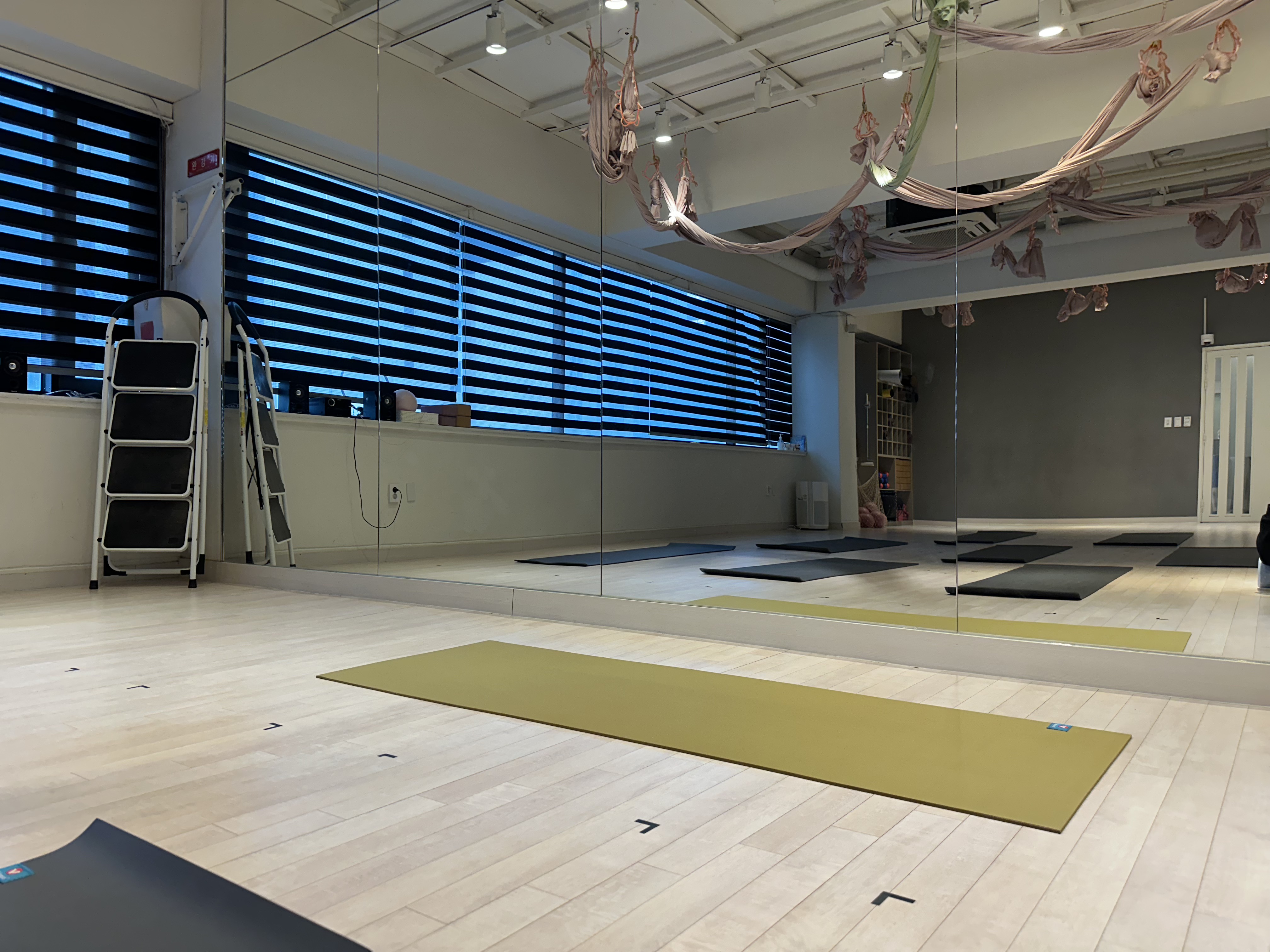
The most impressive part for me personally was my shoulders.
I had a previous shoulder injury, and while I’d been consistently doing pre-workout stretching, there was always a lingering feeling that something wasn’t quite released.
But after the Pilates class, my shoulders and upper body felt much more relaxed.
They released more deeply than my usual stretching, and my movements became smoother.
Of course, I can’t conclude that one session created a noticeable change.
But if this pattern repeats,
I definitely sensed that it could be quite effective for things like rounded shoulders or postural correction.
2. My Worry About Group Classes Was Unfounded
― Immediate feedback created by mirrors
Before the trial, I had this concern:
“In a group class, can the instructor really watch everyone’s form?”
To cut to the chase, they watched much better than I expected.
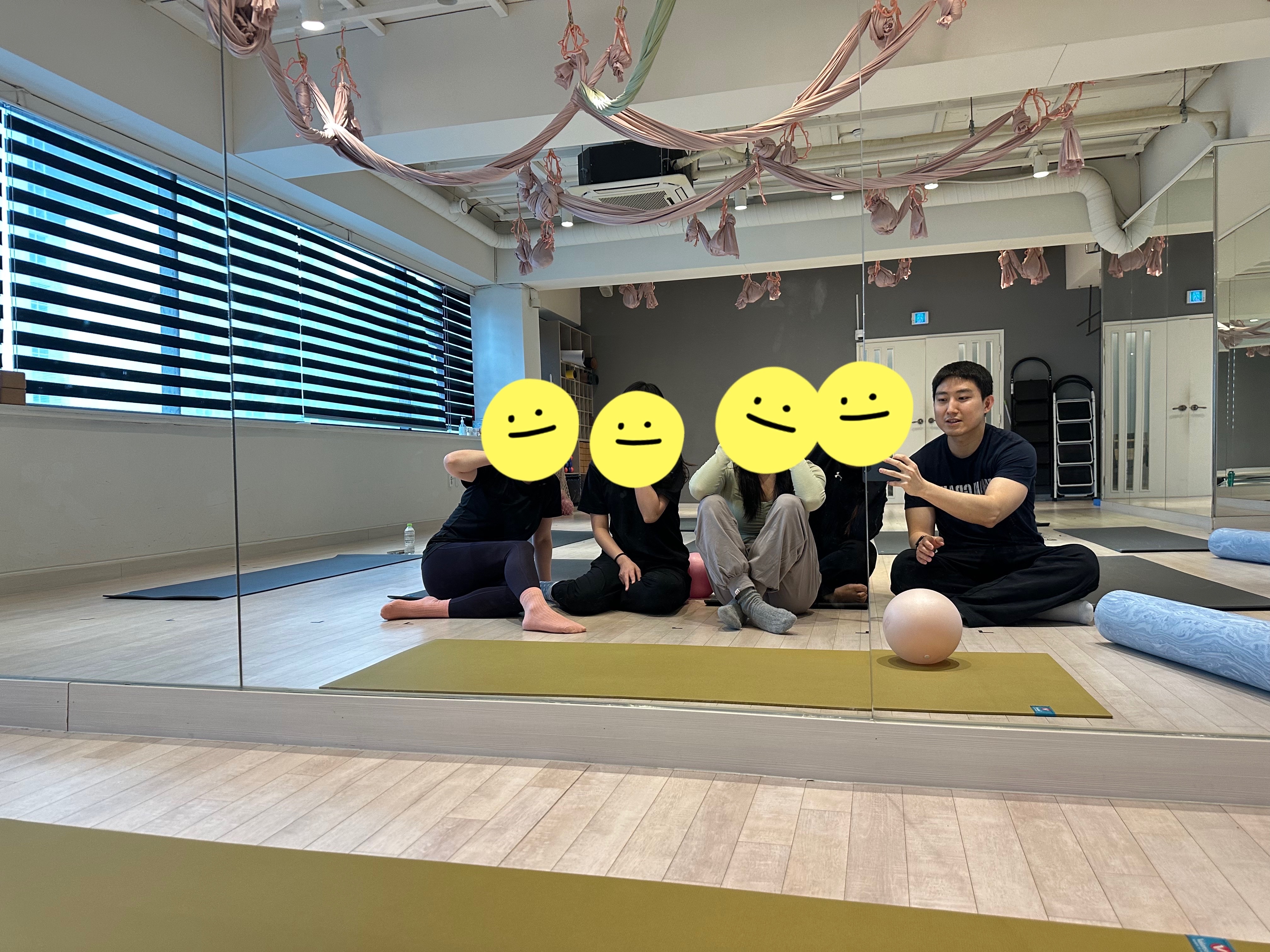
What particularly impressed me was the mirrors placed all around.
- I could immediately check my own movements
- I could follow along while watching the instructor’s form directly
- I understood correction points much faster
Also, when I think of Pilates, awkward positions sometimes come to mind,
but during the actual class, those moments were almost nonexistent.
It’s more accurate to say I was too focused on the movements to have room to worry about that.
3. Reorganizing the Class as a ‘Sequence’
― Pilates Sequence Note
What was interesting about this experience was that
the class wasn’t just a list of movements, but had a clear flow (sequence).
So I reorganized the class in the
Sequence Note format that Pilates instructors actually use.
Pilates Sequence Note: Small Equipment Stabilization & Articulation Program
- Prop: Mat, foam roller, mini ball
- Focus: Core stabilization (Powerhouse), spinal articulation, mobility
| Stage | Exercise | Equipment | Main Focus & Teaching Points |
|---|---|---|---|
| Warm-up | Standing Neutral & Shoulder Roll | - | Proper alignment awareness, shoulder tension relief, and lower trapezius engagement |
| Standing Roll Down & Up | - | Spinal segmental awareness, neck and hamstring release | |
| Seated | Arm Lift (V-shape) | Foam roller, ball | Maintain pelvic neutrality, hold ball with inner thigh (adductor) strength |
| Round Back (C-Curve) | Foam roller | Spinal flexion through abdominal contraction, lumbar stabilization | |
| Flat Back | Foam roller | Use hip hinge, back muscle extension and core control | |
| Spinal Rotation | - | Maintain vertical crown extension, thoracic-centered rotation | |
| Mobility | Quadruped Cat-Cow | Foam roller | Expand thoracic mobility in quadruped position, stabilize shoulder girdle |
| Kneeling Lunge & Side Bend | Mini ball | Stretch iliopsoas (front of hip), release lateral line | |
| Prone | Swan Prep (Upper Back Ext.) | Foam roller | Upper thoracic extension, pull roller with latissimus dorsi strength |
| Release | Thoracic Massage & Opening | Foam roller | Thoracic massage and rounded shoulder correction, chest muscle release |
| Supine | Pelvic Rotation (Table Top) | Foam roller | Place roller on sacrum and rotate lower body, glute and lumbar mobility |
| Main/Last | Rolling Like a Ball | - | Massage effect on spine, core rebound control and balance sense |
| Cool-down | Seated Stretch | - | Overall body tension release and class conclusion |
The class had this structure:
- Alignment awareness (Warm-up) →
- Core·Spine control (Seated) →
- Mobility expansion →
- Posterior strengthening & release (Prone / Release) →
- Integrated movement (Main) →
- Cool-down
What particularly impressed me was:
- Every movement was connected like a preparation stage for the next
- The emphasis was consistently on “how well can you control” rather than “how hard”
This was a different kind of exercise experience from CrossFit or other high-intensity workouts.
4. If It’s Not Recorded, It Disappears
― Exercise experiences depend more on ‘documentation’ than ‘memory’
During the trial, I also recorded the class.
The instructor’s cues, breathing instructions, and alignment points were
information that would quickly fade if I relied solely on memory.
As I transcribed this into text
and structured it as a sequence, I felt it again.
Exercise experiences depend more on ‘documentation’ than ‘memory’.
This perspective is also a topic I want to continue exploring in sqnc.today.
Not just the exercise itself,
but how to preserve its flow and context.
5. Questions Left for the Next Experiment
― In search of the essence of sequence
- How do Pilates instructors actually design sequences, and how do they remember them?
- Where does the structure that enables individual feedback even in group classes come from?
- How much of this sequence and cueing can be transferred to digital documentation?
I’m still at the trial stage,
but this Pilates class was more than just “trying another exercise”—
it was an experiment that expanded my perspective on exercise once more.
Next time, I want to break down this sequence into smaller pieces
and examine it again from the instructor’s perspective.
[Next Sequence]
This sequence was
a time to reconsider
the structure of exercise and the meaning of documentation
through the new experience of Pilates.
In the next installment, I’ll
- analyze the Pilates sequence more deeply
- explore sequence design principles from the instructor’s perspective
- search for the essence of sequences that can be transferred to digital documentation
The next log will continue with
structuring exercise sequences and documentation methodology.