Shoulder Killed My Knee
[Sequence Log 013]
Shoulder Killed My Knee
Last week I had shockwave treatment for my right shoulder (ligament tear, inflammation, calcification).
(Previous post: rehab visit after deadlift PR, subjective awareness and recovery)
I kept training for two weeks using substitute movements so I could maintain WOD intensity without stressing my shoulder.
But there were almost no upper-body movements that didn’t involve the shoulder, so lower-body volume grew too large.
Lower-body fatigue built up; around day 13 my knees started to feel uncomfortable—not quite pain, but not right.
This morning both knees felt stiff and off, so I canceled today’s and tomorrow’s classes and chose to rest.
Two-Week Training Log
| Day | Strength / Skill | WOD / Metcon |
|---|---|---|
| 2 | 80kg x 6rpes x 4sets | AMRAP 12min: 9 V-up / 9 Box jump over / 9 Goblet squat (15kg) |
| 3 | Barbell row, Push-up | AMRAP 12min: Dumbbell box step-up |
| 4 | — | EMOM 10rds: Rowing 15cal / 6 Burpee box jump / 12 Jump Lunge |
| 5 | Deadlift 43kg 10 reps x 4sets | Intervals 10rds: 7 Bar lateral Burpee / 5 Deadlift (70kg) or Plate Sit-up |
| 6 | Squat 10 x 60kg x 2sets, 10 x 80kg x 2sets | For Time 4rds: Rowing 15cal / 12 DB Deadlift / 9 DB Squat / 6 V-up |
| 10 | Plank, Alternating V-up | For time 20min (team of 2): Rowing 1KM / 100 push-up / 100 box step-up / 100 box jump over / 100 burpee box jump over |
| 11 | Squat 100kg x 5sets x 5rounds | AMRAP 12min: Rowing 12cal / 8 DB Deadlift / 6 DB lateral burpee |
| 12 | Sumo Deadlift 100kg x 5reps x 5rounds | Intervals 7rds: 12 SDHP / 14 V-up |
| 13 | Squat 63kg x 15 / 73kg x 15 x 2sets / 93kg x 12 x 2sets | For time 15min: DB Deadlift 40 / DB Lunge 40 / Rowing 40cal → 30 → 20 |
| 14 | Mountain Climbing 1H | — |
| 15–18 | Rest | — |
| 19 | Squat 1RM test | For time 12min: 100 air squat / 80 front lunge / 60 push-up / 40 sit-up / 20 burpee |
1. Shoulder Injury and Two Weeks of Choices
― Keeping intensity with substitute movements
After the rehab diagnosis (ligament damage, inflammation, calcification) and shockwave treatment,
the doctor recommended about two weeks off, but instead of full rest I chose to keep showing up and sub movements that didn’t use my shoulder.
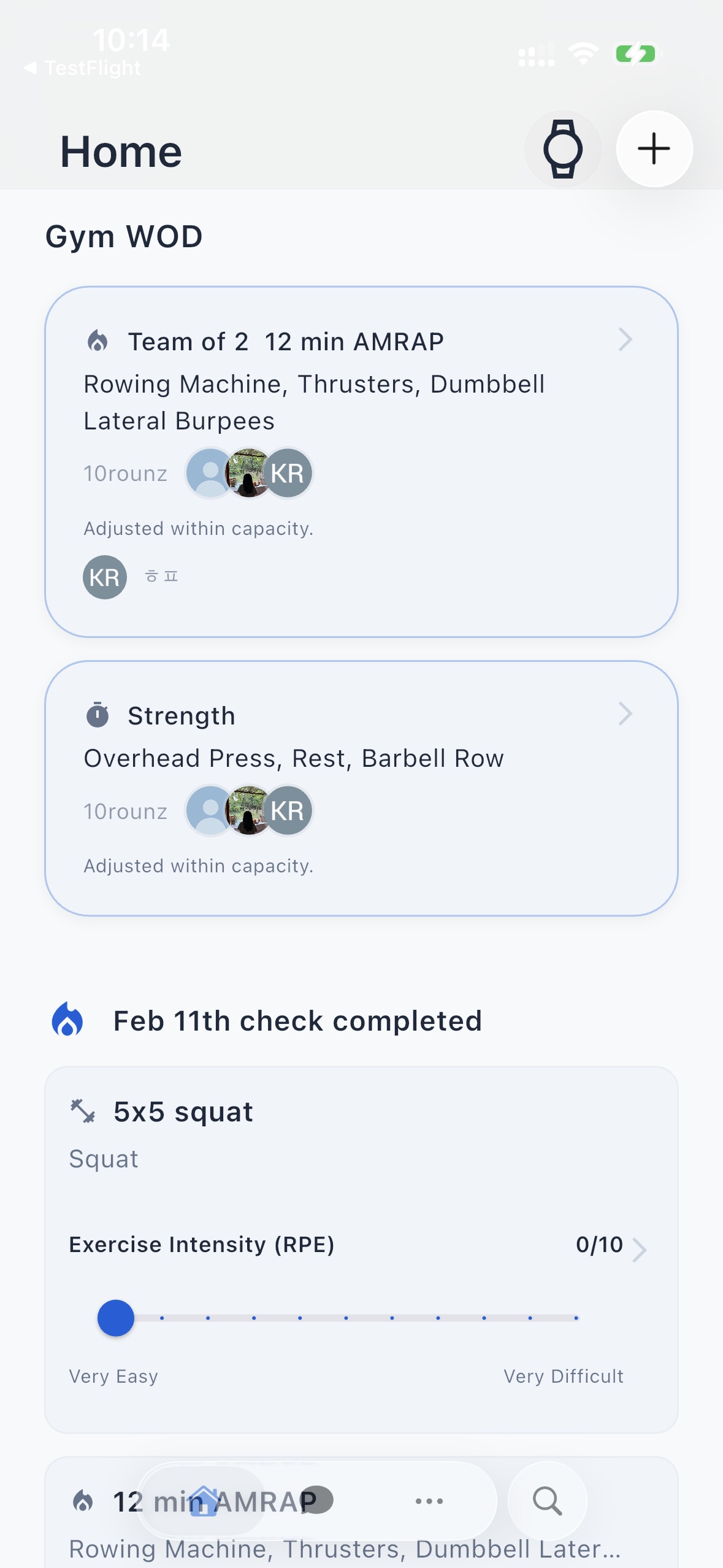
I did box step-ups instead of push-ups, goblet squats instead of thrusters, and leaned heavily on rowing, lunges, deadlifts, and squats for two weeks.
The problem was that there were hardly any upper-body options that didn’t involve the shoulder.
So lower-body work took over.
2. Two Weeks of Accumulating Lower-Body Fatigue
― Day 13: knees start to feel off
With squats, deadlifts, lunges, box jumps, and rowing repeating, lower-body load kept stacking.
It wasn’t clear pain yet, but by around day 13 I started to feel discomfort in my knees.
I told myself that the Lunar New Year break would fix it—I’d rest from the box and let my body recover.
3. Lunar New Year: Rest Without Recovery
― Too much sitting, too little movement
During the holiday I didn’t go to the box and rested from formal training.
But I spent most of the time sitting for development work, and didn’t walk or move much.
I had rested from training, but how I rested was the issue.
With almost no movement, circulation and recovery likely didn’t get much help.
I suspect that’s why recovery felt slower rather than faster.
4. After Squat 1RM and 60 Push-Ups
― The morning my knees felt stiff
Yesterday (Thursday) I did a squat 1RM test and, in the WOD, did 60 push-ups for time—the first time in almost two weeks.
I didn’t feel anything wrong that day, but when I got up this morning both knees felt stiff and off.
I canceled today’s and tomorrow’s classes and chose to rest.
I’m still thinking about how to recover better and faster.
What I Did About It
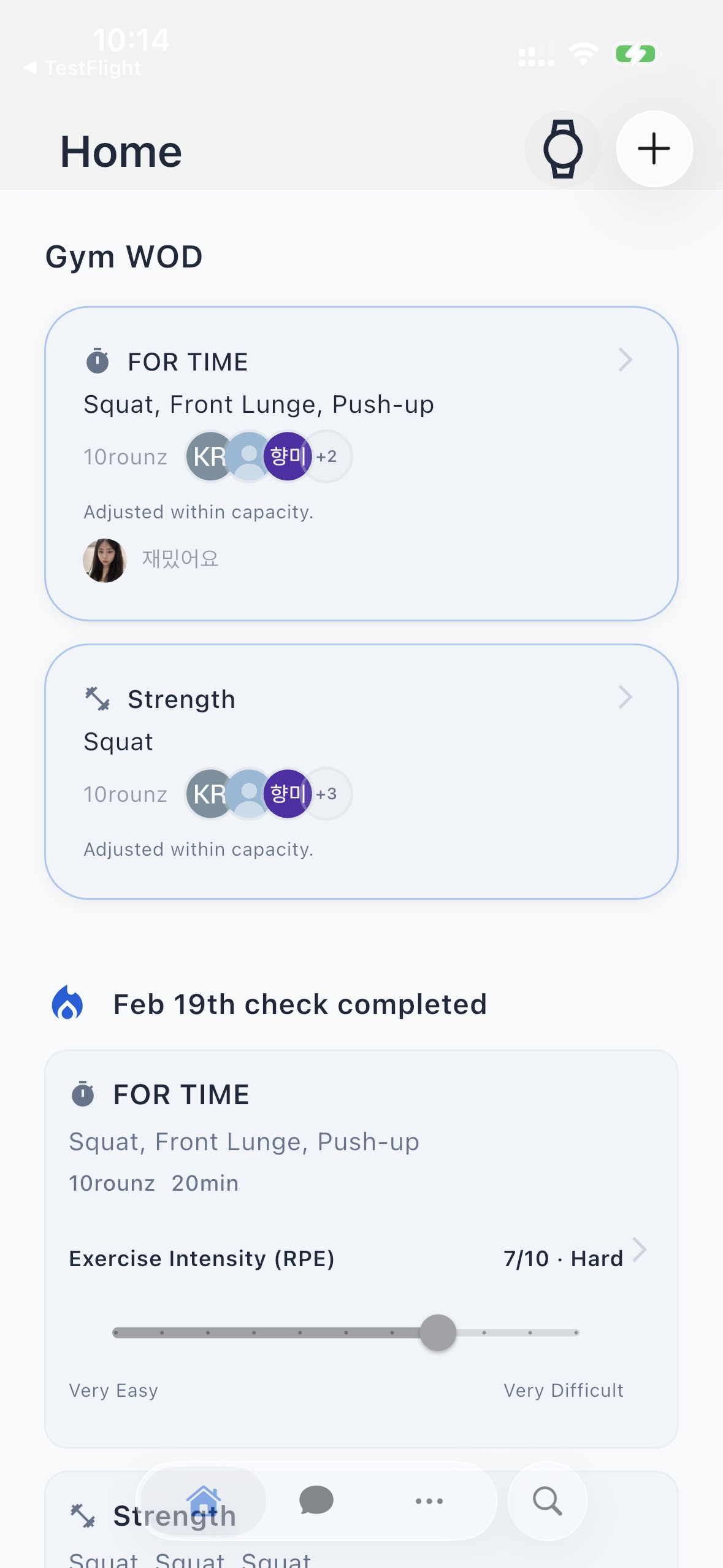
- I bought knee sleeves to protect my knees.
- Thanks to 박재훈
5. Why I Didn’t Use What the App Offers
― The compulsion to train every day
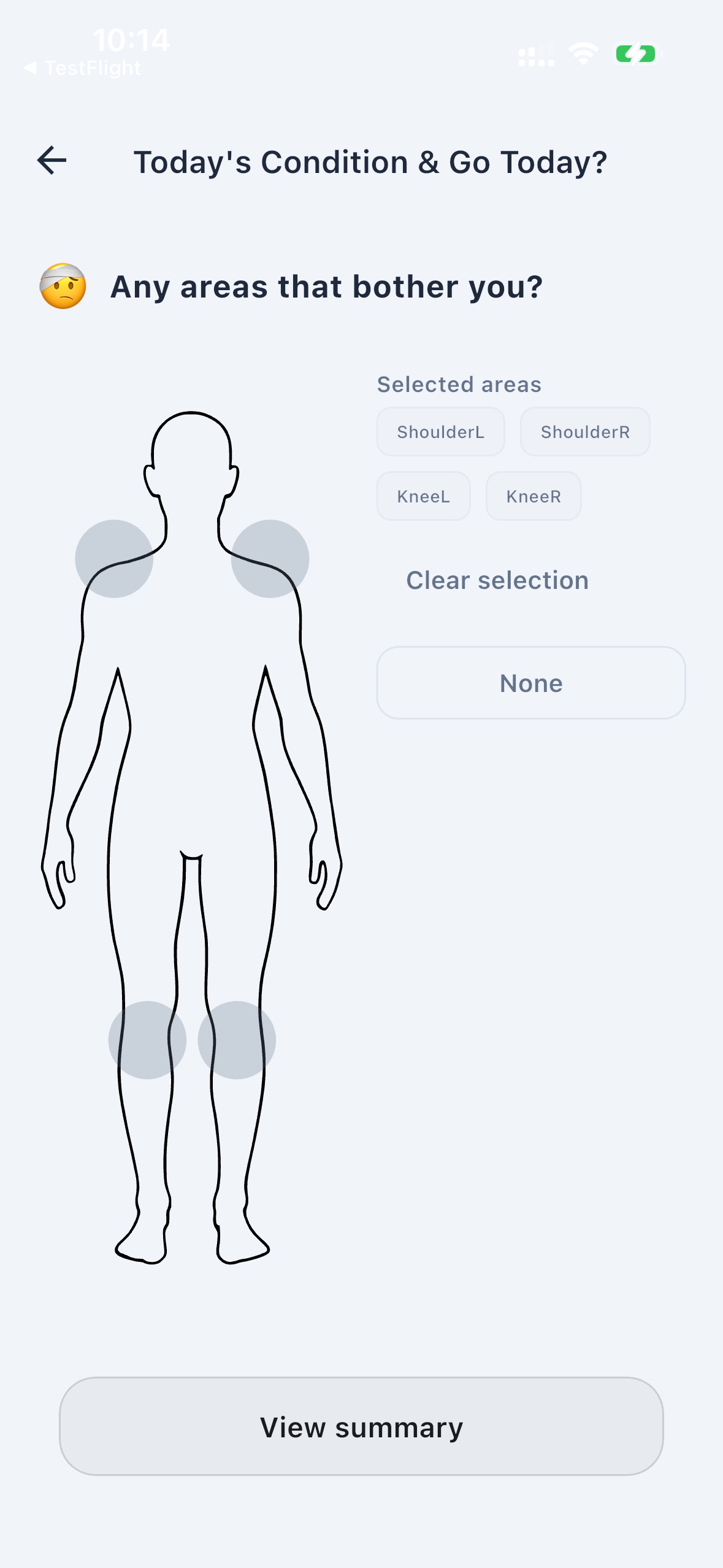
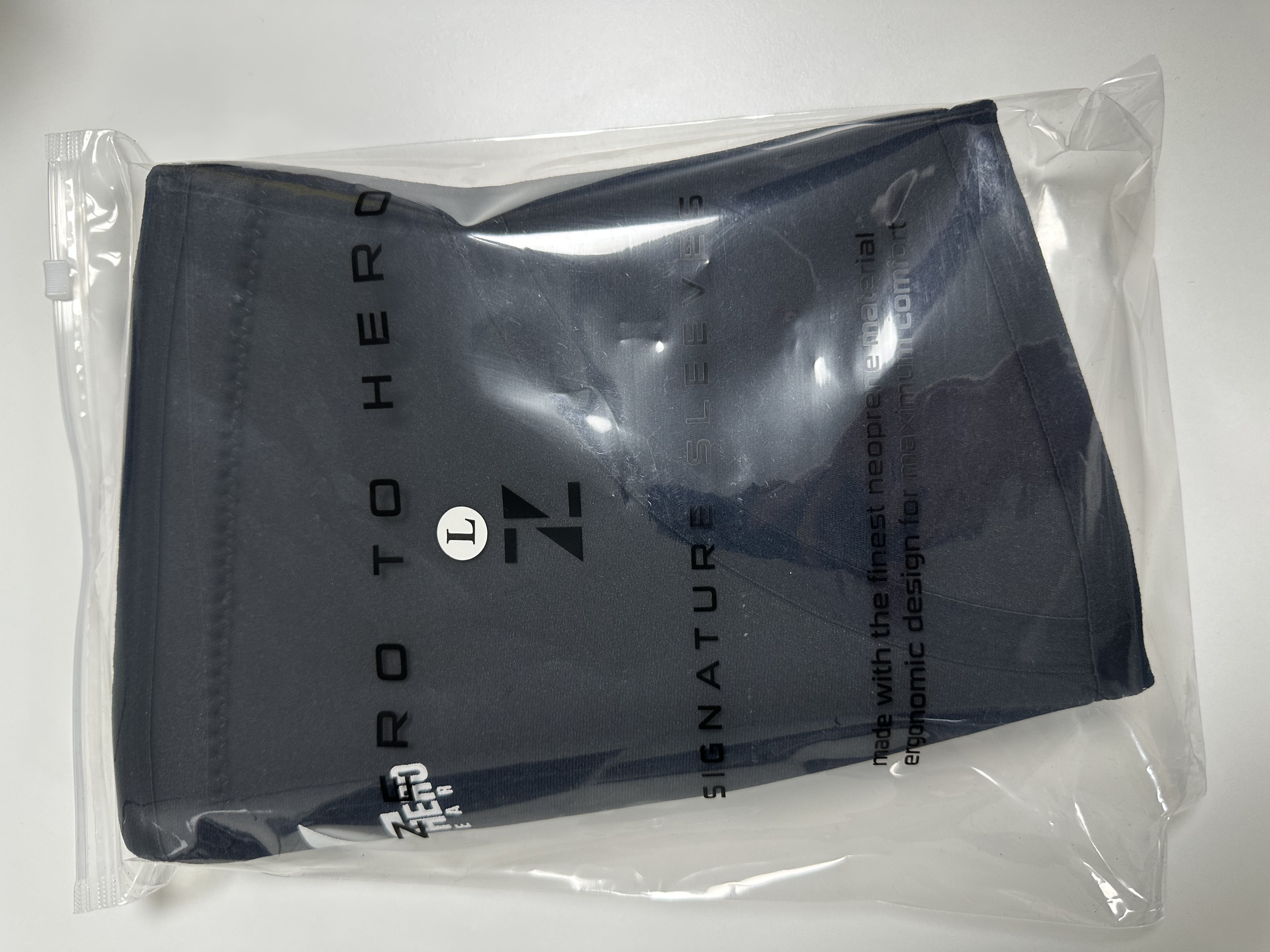
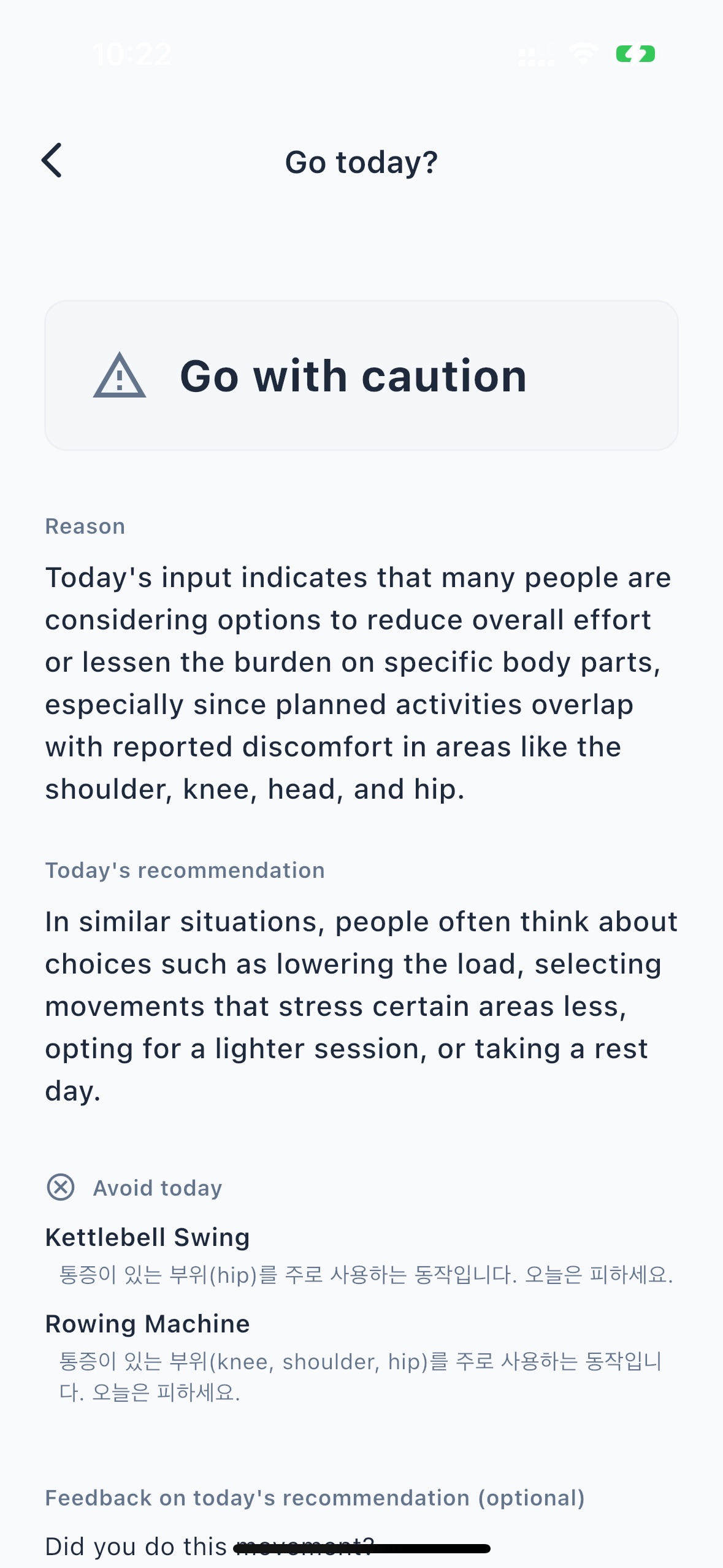
The app already has features to log body condition, adjust scaling, and suggest substitute movements.
In practice, I didn’t really use them.
Looking back, I think the main reason was the compulsion to go every day.
If I skipped training, I felt I hadn’t done what I was supposed to do.
And even when work or life felt stuck, that clear, simple block of time at the gym gave me a sense of having done something—and I kept going for that feeling.
But I’ve come to believe we need the wisdom to adjust each day’s training based on overall condition, injury status, training context, and unexpected events.
6. The Wisdom of Adjusting Every Day
― Making the service something I can trust and use
The service we run already includes flows for condition, scaling, and rest recommendations.
The conclusion I’ve drawn is that I need to improve it further so that I can trust it and actually use it in my own routine.
Injury prevention is the foundation of every goal.
(I said the same in the previous post: rehab visit after deadlift PR.)
Trying to protect my shoulder, I overloaded my lower body, and that load reached my knees.
We need the wisdom to adjust each day’s training based on
overall condition, injury status, training context, and unexpected events.
The next step is to bake that wisdom into the product so that I—and others—can actually follow it.
[Next Sequence]
This sequence was a week where two weeks of substitute training after a shoulder injury led to lower-body overload and knee discomfort,
and where I didn’t use the app’s condition and scaling features because of the compulsion to go every day.
Next, I’ll continue with how we’re baking the wisdom of adjusting each day’s training into the service—
and making it something I can trust and use in my own training.