After a Deadlift PR: Rehab Visit and What I Learned
[Sequence Log 010]
After a Deadlift PR:
Rehab Visit and What I Learned
Yesterday I hit a deadlift PR.
Today my lower back ached and the shoulder pain that had been lingering wouldn’t leave my mind.
I decided to visit a rehab clinic.
(Previous post: coach’s injury, subjective awareness and recovery)
1. Why I Decided to Go
― A conversation with the coach
A week ago, a coach at my box said they were taking a break from training because of a shoulder injury and were going to rehab.
They were getting high-frequency treatment and had already spent a significant amount on care.
They had inflammation and calcification; the doctor had identified the issue, but they said their body was itching to move again.
I had discomfort in my right shoulder after Olympic lifts and push-ups, so I asked about their symptoms and how they were managing.
Listening to them, I thought: I should get checked too.
2. The Visit and the Diagnosis
― From intake to ultrasound
I searched for nearby rehab and orthopaedic clinics and chose one that had recently opened and was running a promotion.
At the visit, they asked where it hurt; in the consultation we went through the details—which muscles, joints, and ligaments were involved.
The diagnosis pointed to the rotator cuff.
They took X-rays and used ultrasound to assess the muscles, ligaments, and joints.
The ligament that should sit in the groove was slightly swollen and shifted to the side.
There was a partial tear, inflammation around it, and some calcification.
The doctor said ligament damage takes time to heal and recommended two weeks of complete rest from training, plus shockwave therapy to support recovery.
After that, I had high-frequency treatment and then a machine-based vibration massage on the affected area.
3. The Deadlift and the Illusion of “Not Using” the Shoulder
― When form drifts, stress goes somewhere else
I had wanted that deadlift PR.
I told myself the deadlift doesn’t really “use” the shoulder.
But that’s not the whole story.
Even when the shoulder doesn’t seem involved,
a small form deviation under heavy load
can stress other areas.
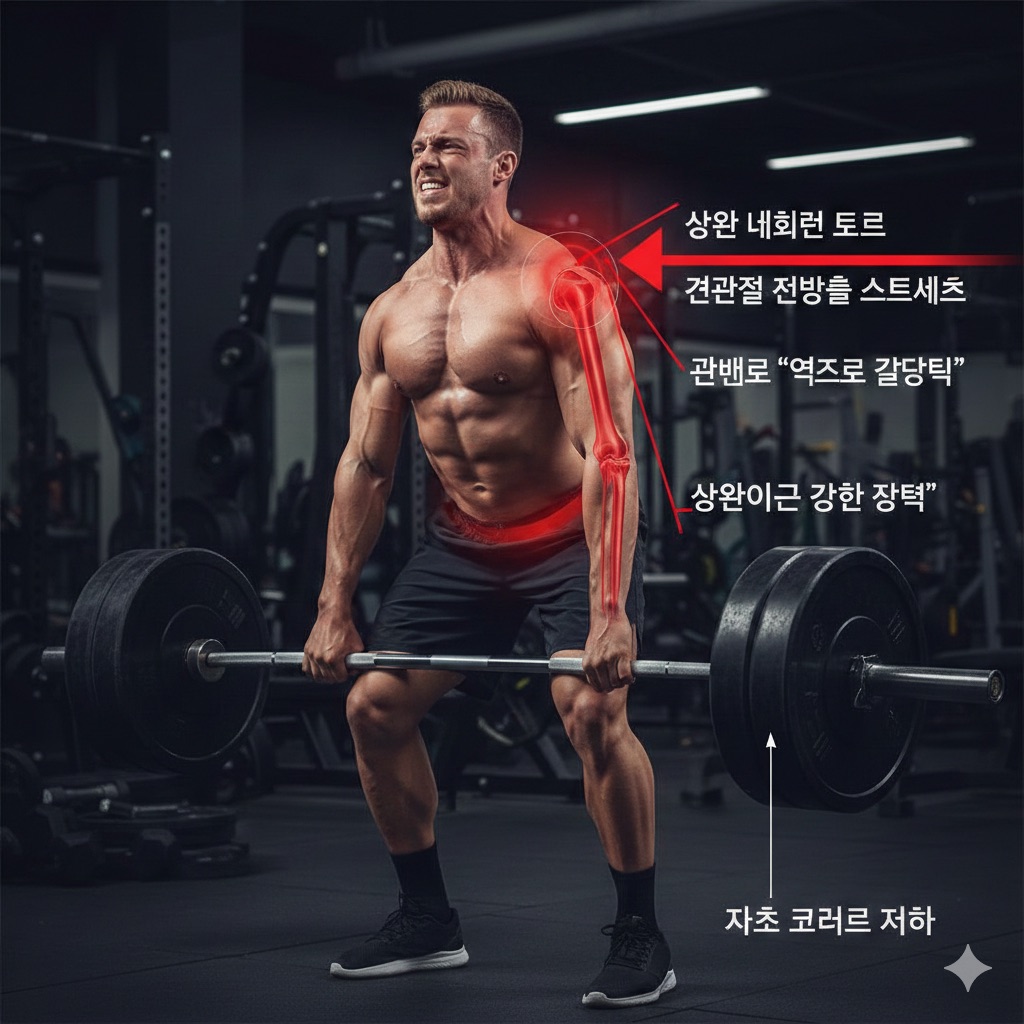
Under heavy weight, the shoulder can still take internal rotation torque and anterior glide stress.
With a mixed grip, the underhand side often bears more of that—internal rotation and anterior shear concentrate on one shoulder.
The biceps can get excessively tense; the core on one side can become the weak link.
Once form drifts, those stresses add up.
I shouldn’t have chased the PR without considering that.
The image above illustrates how stress can concentrate on the shoulder, biceps, and core when deadlift form is off—even when we feel we’re “not using” the shoulder.
4. Treatment and What the Physical Therapist Said
― Shockwave, vibration, and a different take from the PT
The shockwave treatment was aimed at the inflamed and damaged areas to promote blood flow and tissue repair.
The therapist said it’s common for this kind of issue to come from poor push-up or dip mechanics, or from sleeping on the side.
They also said that when the biceps curl is loaded too heavily with bad form, it’s not just the biceps working—the shoulder gets involved and can get pinched.
Interestingly, the PT said that light movement within a pain-free range was okay, while the doctor had recommended two weeks of full rest.
I’m taking the doctor’s advice for now and avoiding heavy or risky movements, and I’ll build back intensity gradually instead of jumping straight back to where I was.
5. It’s Not Just the Prime Movers
― Weak links need checking too
This experience reinforced something:
We need a system that can check not only the prime movers
but also the areas that are usually weak or at risk.
The deadlift is a posterior-chain exercise, but under heavy load and with slight form issues, the shoulder, biceps, and core can become the weak links.
I couldn’t see that clearly by feel alone.
A more precise way to monitor which areas are taking undue stress—and when to adjust or substitute—would help.
6. No Room for Reckless Ambition; Alternative Movements Matter
― Reflecting existing injury in how we train
I shouldn’t have pushed for that PR with my shoulder already niggling.
Going forward, I want to respect existing issues and adjust.
Avoid reckless ambition.
Reflecting existing injury in alternative movements and load management is essential.
Injury prevention is the foundation of every goal.
If I get injured, I can’t pursue any of them.
No matter how big the target, injury makes it unreachable.
So: reduce load when needed, choose alternative movements when the primary one isn’t appropriate, and build intensity back slowly.
That’s the takeaway from this rehab visit.
[Next Sequence]
This sequence moved from a coach’s injury and subjective awareness of pain
to a concrete rehab visit and diagnosis.
Next, I’ll continue to explore:
- How subjective sensation and objective monitoring can work together
- What kind of system could help check not only prime movers but weak or at-risk areas
- How to integrate injury awareness, recovery, and training into one approach
The next log will keep building toward
integrating injury prevention, recovery monitoring, and smarter choices after training.